|
Beating the Big C, the Mitcheldean Garden
2020 |
||||||||||||||||||||||
|
This page is part of a series of garden blogs from 2020. Click here for the index. Yuehong has always loved roses, it seems that it started long ago when she first encountered European culture. They appeared in paintings and were for ever being mentioned in the classic novels which of course she originally read in translation. By the time I appeared on the scene she was completely hooked and when we established a house and garden near the Great Wall in China, one day a truckload of roses appeared at the gate. Fortunately, roses weren't fashionable in China and she had secured them at a knock down price, the one problem being that the people who had sold them to her had no idea what colour they were - in the UK they would be called 'Lost Label Roses' but these had never had a label. Considering the extreme cold of winters in the area, we did well to lose only one or two a year on average, this being taken in our fourth year there.
One of the promises she extracted from me when we moved to the UK was that she could have as many roses as she could fit in the garden. Fortunately, the thought of climbing to the upper reaches used to be a nightmare so they stop at the level of the summer house, I believe there were once more than 80 but hot dry summers have reduced that number somewhat. Our local water company provides slightly alkaline tap water, it seems that this is to inhibit corrosion of old iron pipes. We have an acid soil and it's not just plants like rhododendrons which dislike the shock of a change in pH compared to rain water, it's just a question of how long it takes for harm to appear. For the last few years I have held back from watering the roses when it dried up in early June and they have had uncomfortable later summers. This year, it has been dry from April, May was a record month for sunshine and our hands have been forced. We tend to have 1000 litres of rain water (yes that's one ton) stored at the start of the growing season but that's rather less than a month's supply and we can stretch it by allowing tap water to stand for a week or more in one of the water butts. In the short term, the results have been spectacularly good. The stronger roses have bloomed very well, the weaker ones have shown more interest in life and it remains to be seen what will happen later his year and next year. The house is built on a concrete raft which extends to the front and this means the roses there have quite shallow roots and of course most of the rain comes from the wrong direction as far as they are concerned. We put this rose in front of my study when we arrived and this year it has vented years of frustration. Yuehong has taken over my job on the morning 'bread run' as I am supposed to minimise social interactions.
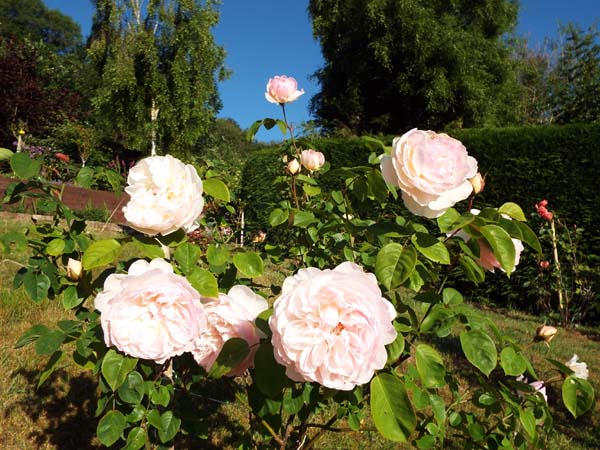
These four David Austin roses are well established and the soil is deeper under them so they need less help, the yellow one (hidden to the left) has never been as strong and the red one on the right is always a late bloomer. Garfield tends to follow us round the garden and he likes sitting on the wall in the early morning susnshine.
At the time, there was no more space in front of the house - later we were to sacrifice the lawn - and we put nine more David Austin roses in the bank behind the bungalow. The result was mixed and years on we can say that maybe five are happy, three are miserable and one has gone to the great rose garden in the sky. The soil cannot be good, moss and weeds thrive but most fuchsias which shoot elsewhere turn their noses up at it.
This is the third happy rose.
That is certainly not the case for our 'Rhapsody in Blue' next to the summer house which has produced dozens of short lived blooms, necessary purple because roses have no genes for true blue.
Click on a picture for a larger version and click on that to return to this page. Our standard roses were universally end of season bargains, the ones at the front have had a better season than those at the back, indeed the three small ones there look terminally unhappy.
Here before the 'main crop' are three with a difference. The first is our Albertine, a climbing rose which catches the sun on the rear wall of the bungalow. It has a single flush, in recent years it has struggled to pump water to its extremities, this year it has fewer but stronger blooms and with its clematis partner has enjoyed being watered frequently. In the middle is what we were told was a hybrid tea rose, but it seems a strong variety. On the right is our Double Delight with two colours and an extraordinary scent.
All the rest of the pictures are of a range of single blooms, remember that typically a rose bud will have a darker and more intense colour than a recently opened bloom and that will become lighter over its lifetime. It's certainly not comprehensive, the pictures were taken 'as available' in early season. I have tried to group those with a similar 'hue', I certainly couldn't begin to name them.
We plan a review at the end of the summer and some underperformers face digging up, we are aware that their replacements should not occupy the same position which may leave the rose garden looking a little irregular in parts. Click here for the next part. |